Editor’s Note: This blog is transcreated based on a YouTube video by Garage Built Hondas. You can watch the full review on their channel. The following captures the key takeaways and driving impressions from their real-world test of the IDDS coilover system.
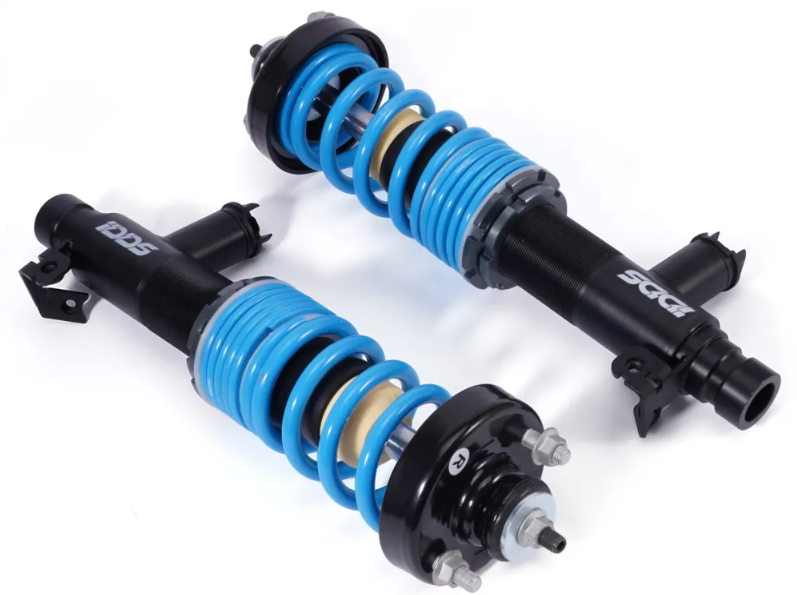
Anyone who has built a lowered Honda knows the trade-off. You chase that perfect fender-to-tire fitment, and in return, the ride turns into something the spine files complaints about. It doesn’t have to be that way. At least, that’s what Garage Built Hondas set out to test when they bolted a set of MaXpeedingRods IDDS coilovers onto their EK Civic and put real street miles on them — not just a quick loop around the block, but hundreds of miles of actual driving.
What followed was honest feedback, some fender liner trimming, and a conclusion that echoed what the engineers behind this kit clearly intended: this suspension rides far better than it has any right to at this height.
Out of the Gate: 40 Miles and a Surprise
Right after the initial install and settling period, the EK Civic hit the road for roughly 40 miles of mixed driving. The first thing the reviewer noticed? The ride height continued to settle evenly — and more importantly, the damping delivered something unexpected.
As they put it, it “rides surprisingly smooth for how low I am keeping it.” That’s the kind of reaction that tells you the valving and spring rates are working in harmony. The Civic sat low, but the suspension didn’t punish the driver for it.
Of course, dialing in a new setup always involves some fine-tuning. The rear tires rubbed slightly against the inner fender liner at that aggressive ride height. A quick trim with a blade cleaned it up while keeping the factory plastic covers in place — a smart move to preserve road noise insulation and debris protection. After that minor adjustment, the reviewer reported no rubbing issues at all.
They also noted the damping adjustment gauge as their least favorite element. The double-sided tape struggled to adhere to the textured interior material. A small gripe, but one worth noting — many builders relocate the gauge to a more permanent pod mount, and Garage Built Hondas mentioned plans to have a custom mount fabricated for a cleaner solution.
The Science That Makes It Work: Linear Front, Progressive Rear
What separates a decent coilover from one that genuinely rides well on the street often comes down to spring design. The reviewer picked up on exactly what’s baked into the IDDS system — a split spring strategy that plays to each axle’s strengths.
Up front, the IDDS uses a linear-rate spring. This means the stiffness stays consistent throughout the compression stroke — predictable, composed, and exactly what you want for steering precision. As the reviewer noted, “it’s generally what we use for the track.”
Out back, however, the equation changes. The rear of a lowered Civic tends to feel bouncy with stiff springs, especially on uneven pavement. That’s why the IDDS runs a progressive-rate spring in the rear. Under light loads, the softer initial rate absorbs road chatter. When the suspension compresses harder, the rate ramps up to maintain control.
The reviewer’s take? Having that progressive spring in the back “is a much-needed answer to help maintain the softer ride quality.” This wasn’t an accident — it’s a deliberate engineering choice, and based on the driving footage, it works.
Three Weeks, 300 Miles: The Daily Verdict
After living with the suspension for about three weeks and logging approximately 300 miles, the real picture emerged.
The reviewer spent most of their time in sport mode but planned to test comfort setting extensively. Even on the firmer damping setting, they reported: “This thing actually feels pretty smooth. It rebounds well. It doesn’t seem to float around in the rear.”
That last point matters. A compliant ride shouldn’t feel floaty or disconnected. The IDDS manages to absorb bumps without losing composure — a balance that’s harder to achieve than most realize.
There were no functional issues. Despite needing to flip the rear damper orientation during install to clear the sway bar mounts (covered in Part 1 of their video), everything mounted up cleanly and stayed that way. No wiring interference. No clearance problems. Just a working suspension that got out of the way and let the driver enjoy the car.
What This Kit Is — And What It Isn’t
To their credit, Garage Built Hondas didn’t overhype the product. They positioned it exactly where it belongs: “I definitely don’t think it’s like a track-oriented suspension. But for most of these Hondas that we work on and build, they generally need something that rides really well.”
That’s the IDDS in a sentence. It’s built for the daily driver, the weekend cruiser, the build that sees more street miles than circuit laps. And at its price point, the reviewer called it “super solid.”
A bonus trust signal came near the end of the video: the reviewer realized they’ve also been running a MaXpeedingRods camber kit for three years without a single issue — no slipping, no bending. Long-term reliability with one product naturally builds confidence in another.
As for the IDDS, the reviewer’s closing sentiment says it plainly: “I’m a fan so far. They are riding awesome.”
The Honda community has always been built on honest feedback and real-world testing. Garage Built Hondas put in the miles and shared their unfiltered experience — the kind of review that matters more than any spec sheet. For anyone looking for a coilover that lets a Civic go low without making the daily commute feel like a punishment, this review is worth the full watch.